

Published July 2, 2026 · By Chris Nevada, Nevada Real Estate Group · NV License S.181401
"What will my budget buy in Sparks?" is the first question most buyers ask me, and it is the right one — because Sparks is the value side of the Reno-Sparks metro, and the same dollar figure buys a very different home depending on which part of the city you shop. In 2026 the median Sparks home sits around $495,000, a bit below Reno, and that number gets you a larger newer home in Spanish Springs, a golf-community home in D'Andrea, or a charming older home near the revitalized downtown. This guide walks exactly what your budget buys by area, then shows how the picture shifts at $400,000 and $600,000.
The median Sparks home costs about $495,000 in 2026 and typically buys a roughly 1,900 to 2,300 square-foot, three-to-four-bedroom single-family home. In newer Spanish Springs and Kiley Ranch that means near-new construction; in central Sparks a larger older home; in golf communities like D'Andrea a smaller home in a premium setting. Area, age, and size are the levers you trade against a fixed budget. Call (775) 277-2120.
- The 2026 Sparks median of about $495,000 buys a 3-to-4-bed home of roughly 1,900 to 2,300 square feet.
- Sparks generally stretches a budget further on square footage than neighboring Reno.
- The newest construction clusters in Spanish Springs and the Kiley Ranch master plan.
- Adding $105,000 (to about $600,000) typically adds 400 to 700 square feet or a golf-community address.
- Nevada charges no state income tax, which stretches every dollar of a Sparks housing budget.
How we know this: Across the 9,600+ closings Nevada Real Estate Group has represented statewide — more than $4.85B in closed volume — a meaningful share sit right around the Reno-Sparks median, so we see what that budget buys every week. In my experience, buyers who name their single top priority first — newest, biggest, or best location — get far more for $495,000 than buyers who try to maximize all three at once. The figures below reflect that transaction experience plus 2026 Northern Nevada market data; confirm current comps for your target area before you write an offer.
What Is the Median Home Price in Sparks in 2026?
According to the Reno/Sparks Association of REALTORS, the median price of an existing single-family home in Sparks sits near $495,000 in 2026 — modestly below Reno, which is why Sparks draws value-focused buyers within the metro. Just as important are the conditions around the number: homes have been selling close to list price with a median time on market in the 40-to-50-day range, which tells you the market is balanced — competitive on well-priced listings, but with room to negotiate rather than waiving every contingency.
We've represented buyers at this price point across all of Sparks, so treat the median as a starting budget, not a house. The real question is what you trade for it — and in Sparks, the biggest trade is newer-and-north versus established-and-central. Sparks has quietly become one of the metro's better value stories: as Reno prices climbed, buyers priced out of central Reno increasingly looked across the line to Sparks, where the same money often buys a newer or larger home. That demand has kept Sparks healthy without pushing it to Reno's price levels, which is exactly the window value-focused buyers want to understand before they shop.
| Area | Typical home | Approx. size | Age | Trade-off |
|---|---|---|---|---|
| Spanish Springs | 3–4 bed single-family | 2,000–2,500 sq ft | Newer (2005+) | North-end commute |
| Kiley Ranch | 3–4 bed single-family | 1,900–2,300 sq ft | Newer / new build | North Spanish Springs |
| Wingfield Springs | 3 bed single-family | 1,800–2,200 sq ft | 1990s–2000s | Golf-community HOA |
| D'Andrea | Smaller SFR or townhome | 1,700–2,000 sq ft | 2000s+ | Hillside golf premium |
| Central / old Sparks | 3 bed single-family | 1,400–1,900 sq ft | Older | Charm over space |
| Sparks Marina area | Condo or smaller SFR | 1,300–1,800 sq ft | Mixed | Location premium |
The pattern is consistent: the newer areas up north in Spanish Springs buy the most square footage for the money, while the golf communities and close-in central areas trade raw size for setting, amenities, or a shorter commute. Explore the area on our Sparks hub, and compare against neighboring Reno and the wider Northern Nevada communities directory.
What Does $495,000 Buy in Spanish Springs and Kiley Ranch?
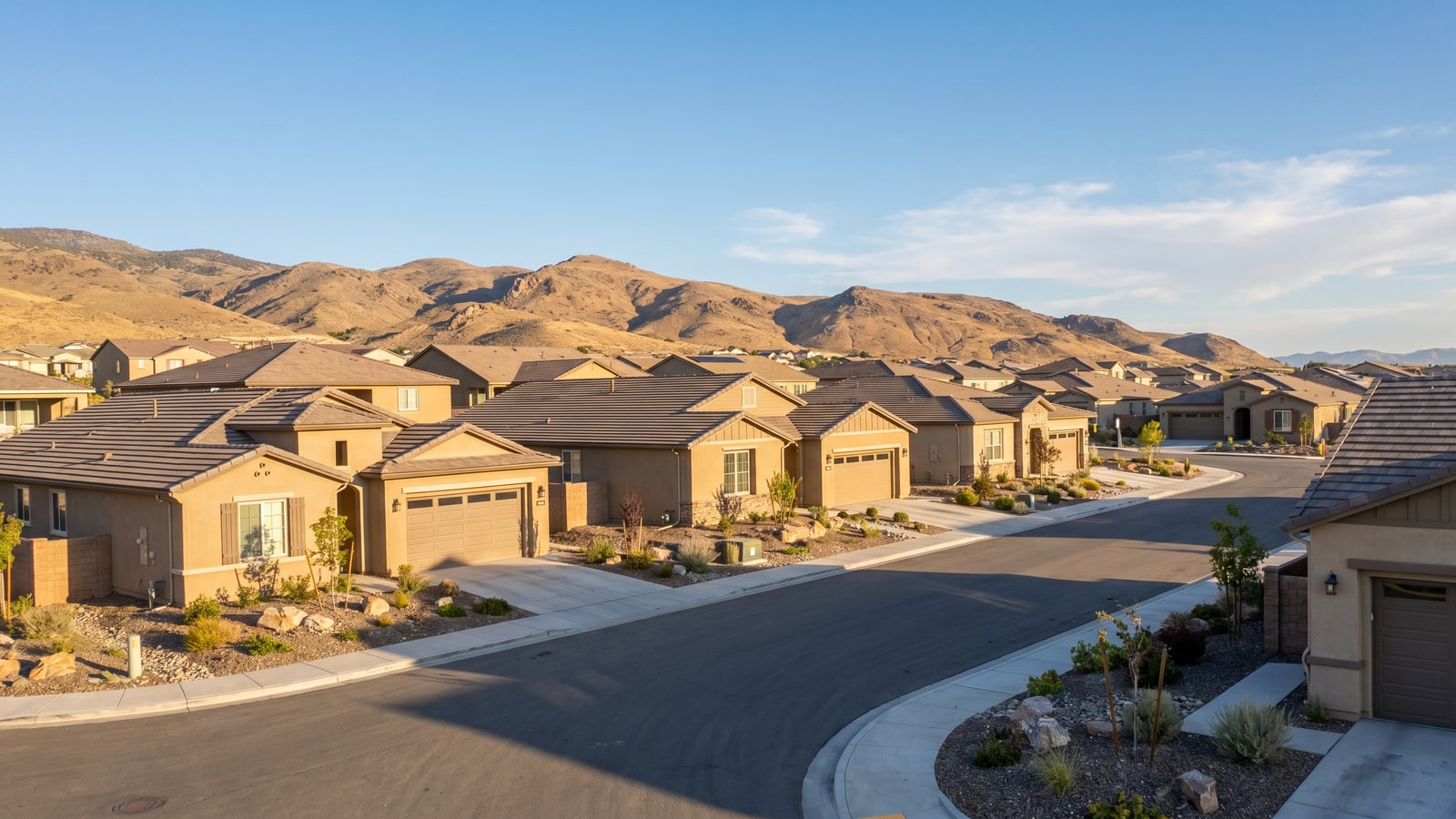
In the newer north-end areas — Spanish Springs and the Kiley Ranch master plan — the median budget buys newer construction, often a home built in the last twenty years or a brand-new build with builder incentives. Expect a two-story, three-to-four-bedroom home of roughly 2,000 to 2,500 square feet, an attached garage, a low-maintenance yard, and contemporary finishes, plus parks and trails in Kiley Ranch. According to Washoe County, much of Sparks's newer residential growth has concentrated in Spanish Springs, which is why the newest and largest homes for the money cluster there.
The trade-off is commute: Spanish Springs sits at the north end of the valley, a longer drive to the south-end and west-side job cores. For buyers who value a modern floorplan, a warranty, and the most square footage for the money, this is the strongest use of the median budget. Compare current new-build options on our new construction hub, and read whether Reno versus Las Vegas fits your relocation plans.
What Does $495,000 Buy in Established Central Sparks?
Shop central and older Sparks — the established neighborhoods closer to downtown, Victorian Square, and the Sparks Marina — and $495,000 stretches to a solid three-bedroom, often on a larger lot with mature landscaping you will not find in the new subdivisions up north. Many of these homes date to the 1970s through 1990s and may want updates, but the location is central and the value is real, especially as downtown Sparks continues to revitalize.
I steer buyers here when they want to be close to the action — the Sparks Marina, Victorian Square events and farmers markets, and quick freeway access to the rest of the metro — and are comfortable trading brand-new construction for an established central location. According to the U.S. Census, Sparks has grown steadily alongside the metro's expanding tech, logistics, and manufacturing base, and demand in the close-in neighborhoods has stayed firm. Weigh these areas on our Sparks hub before deciding.
What Does $495,000 Buy in Sparks Golf Communities?
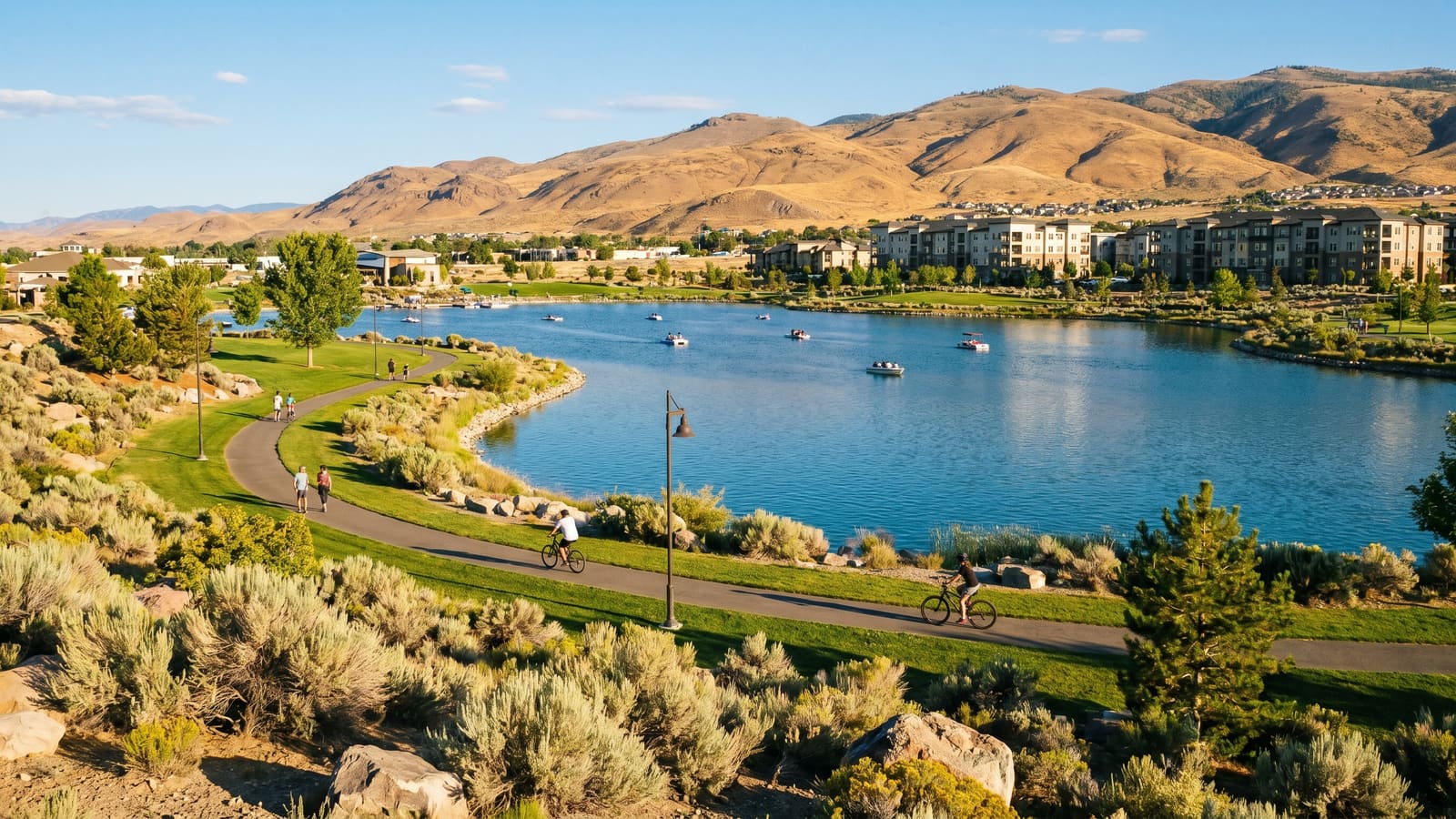
In Sparks's golf communities — Wingfield Springs and the hillside D'Andrea — the median budget changes shape. Here $495,000 often buys a smaller single-family home or a townhome rather than a large detached house, because the flagship product in these golf-oriented communities starts higher. The upside is that you are buying into the amenities, the views, and the resale strength of Sparks's most sought-after settings — a smaller home in a premium community can outperform a bigger house in a weaker location.
I bring these communities into the conversation for buyers who prioritize setting and lifestyle over raw size, or who are downsizing. According to the Federal Housing Finance Agency, the Reno-Sparks metro has posted strong long-run appreciation, and the golf communities have generally led it within Sparks. Explore comparable settings across the region on our luxury communities page, or read our Reno relocation guide for the wider move.
How Does the Price Ladder Change What You Get in Sparks?
The median is just one rung. Move up or down about $95,000 to $105,000 and the home changes materially. The ladder below shows how the typical Sparks home shifts across three price points at 2026 pricing.
| Budget | Typical home | Size | Best-fit buyer |
|---|---|---|---|
| about $400,000 | Condo, townhome, or older single-story | 1,300–1,700 sq ft | First-time / budget |
| about $495,000 (median) | 3-to-4-bed single-family | 1,900–2,300 sq ft | Move-up / typical |
| about $600,000 | 4-bed newer or golf-community home | 2,400–2,900 sq ft | Growing family / move-up |
Notice how much leverage that step carries in a market like this. Dropping to $400,000 usually means an attached home or an older single-story; stepping up to $600,000 often adds a full extra bedroom, 400 to 700 more square feet, or a sought-after golf-community address. According to Freddie Mac rate data, small mortgage-rate movements swing your buying power by tens of thousands of dollars, so getting pre-approved before you shop tells you which rung you are actually on.
Should You Buy New Construction or Resale in Sparks at the Median?
Both work at $495,000, and the right answer depends on what you value. New construction in Spanish Springs or Kiley Ranch gets you a modern floorplan, a builder warranty, energy efficiency, and 2026 incentives like rate buydowns and closing credits — but a north-end location for the money. Resale in central Sparks or an established golf community gets you more square footage, mature landscaping, or amenities, but older systems and finishes.
| Factor | New construction (about $495K) | Resale (about $495K) |
|---|---|---|
| Location | North Spanish Springs / Kiley Ranch | Central Sparks / golf communities |
| Size for the money | Large, new | Larger or amenity-rich |
| Condition | Brand new, warrantied | Older, may need updates |
| Incentives | Builder rate buydowns / credits | Seller concessions possible |
| Lot / trees | Smaller, new landscaping | Often larger, mature |
In my experience, buyers who prioritize a move-in-ready modern home lean new, while buyers who want space, a central location, or golf amenities lean resale. I've toured both sides of this trade many times across Sparks, and the deciding factor is almost always which compromise you can live with daily and how your commute lines up.
What Does It Cost to Own a Median Sparks Home Each Month?
Purchase price is only the start — your real cost is mortgage principal and interest, property taxes, insurance, and any HOA dues. According to Washoe County, Nevada taxes property on assessed value with statutory abatement caps that keep the tax line moderate, and there is no state income tax per the Nevada Department of Taxation. On a $495,000 home with roughly 10 to 20% down at 2026 rates, most buyers land somewhere in the high-$2,000s to low-$3,000s per month all-in, before HOA.
Here is a concrete example. On a $495,000 home with 10% down, you finance about $445,500. At a 2026 conventional rate, principal and interest land near $2,850 a month, property taxes add roughly $250, homeowners insurance about $125, and mortgage insurance perhaps $155 until you reach 20% equity — before HOA. Add a modest $50 HOA and you are near $3,430 all-in; add a $150 golf-community HOA and you cross $3,530. Put 20% down instead and you drop the mortgage insurance entirely and shave the principal, pulling the payment back toward the high $2,000s. Those savings, multiplied across a 30-year loan, are exactly why I model the full picture — and Sparks, like the rest of Northern Nevada, carries real winter operating costs a warmer market does not, so I fold heating and snow-season upkeep into the conversation.
How Much Income Do You Need to Buy a Median Sparks Home?
A common rule of thumb is that your all-in housing payment should stay near or below about a third of your gross income, though lenders qualify many buyers higher. On a $495,000 home, once you factor principal, interest, taxes, insurance, and any HOA at 2026 rates, most households need somewhere in the range of roughly $115,000 to $145,000 in annual income to qualify comfortably with a moderate down payment — less if you put more down or carry little other debt, more if rates are elevated.
The good news is that Nevada's lack of a state income tax stretches every dollar of that income further than it would across the state line in California. According to the U.S. Census, Sparks household incomes have risen alongside the region's growing base in logistics, manufacturing, and technology, part of why median-priced demand stays steady. I always start buyers with a real pre-approval so we anchor the search to what you actually qualify for. Our buyer resources walk through the affordability math step by step.
What Down Payment and Loan Options Work in Sparks?
You do not need 20% down to buy a median-priced Sparks home. Conventional loans allow as little as 3 to 5% down, FHA loans allow 3.5% with more flexible credit, and VA loans offer qualified veterans zero down — a meaningful benefit given Northern Nevada's veteran population. On a $495,000 home, that is the difference between roughly $14,850 and $99,000 up front, which is often the real constraint for buyers, not the monthly payment.
The trade-off with a lower down payment is mortgage insurance and a slightly higher monthly cost until you build equity, so we model each scenario against your cash reserves and timeline. According to the Consumer Financial Protection Bureau, comparing loan estimates from multiple lenders can save borrowers thousands over the life of the loan, so never take the first quote. A larger down payment removes mortgage insurance, but tying up cash you may need for the realities of Northern Nevada homeownership — snow removal, heating, and the occasional roof or furnace repair — is its own trade-off I walk buyers through.
Which Sparks Neighborhoods Offer the Most for the Median Budget?
A few areas consistently deliver the most home for around $495,000. Spanish Springs and Kiley Ranch up north offer newer, larger homes for the money, trading a longer commute for square footage. Central and older Sparks stretches the budget on value and location near downtown and the Marina. For amenities, Wingfield Springs offers established golf-community living, sometimes within reach at the median.
D'Andrea and the hillside areas stretch the budget least on size but most on views and setting. According to the Reno/Sparks Association of REALTORS, these submarkets each move at slightly different speeds through the year, so the best value shifts month to month with new-home releases and resale supply. I keep a live read on which area is offering the most at any given time. Browse them on our Sparks and Northern Nevada communities hubs, or start a home search filtered to your budget.
How Fast Do Median-Priced Homes Sell in Sparks?
Speed matters when you are shopping the median, because that price band is the most active part of the Sparks market. According to the Reno/Sparks Association of REALTORS, homes have generally been selling close to list price with a median time on market in the 40-to-50-day range in 2026 — balanced enough to negotiate, but active enough that the best-priced, best-condition homes still move quickly and occasionally draw multiple offers. The median band, roughly $445,000 to $545,000, is where the largest pool of Sparks buyers competes.
There is a seasonal rhythm to it as well. Spring and summer bring the most inventory and the most competition, while the snowier winter months typically slow down and hand patient buyers more leverage. In my experience, buyers who are pre-approved and clear on their priorities can act within a day or two of the right home hitting the market, which is often the difference between winning and losing a well-priced Sparks house in the busy season. That is why I front-load the preparation before we ever tour.
Sparks's demand story also underpins that pace. The region's job base has broadened well beyond gaming into logistics, advanced manufacturing, and technology, much of it concentrated at the nearby Tahoe-Reno Industrial Center, drawing steady in-migration from higher-cost West Coast metros. Many of those relocating buyers cross-shop Sparks against California markets where the same money buys far less, so Northern Nevada's combination of no state income tax and relative affordability keeps the median band competitive even when the broader national market cools. That structural demand is why I tell median-budget buyers not to wait for a dramatic price drop that rarely comes here — the better strategy is to buy the right home in the right area at a fair price and let the region's growth work in your favor over a five-to-ten-year horizon.
What Mistakes Should Sparks Budget Buyers Avoid?
The most expensive mistake I see is shopping on price alone and ignoring the all-in monthly cost. Two $495,000 homes can carry very differently once you add a high-HOA golf community, a special assessment, or an older home's insurance and repair costs. The second mistake is stretching to the top of your pre-approval and leaving no cushion for furniture, repairs, or a rate change mid-search.
A third trap is falling for square footage in a location that does not fit your commute or the weather. A bigger north-end home can add real winter drive time to south and west job centers, so I push buyers to weigh location against raw size, especially with Sparks's elevation and snow season. Finally, do not skip the inspection to win a bid — at the median you have negotiating room, and a modest inspection fee can surface a five-figure problem. If you also need to sell a current home to fund the move, our seller resources cover timing the two transactions.
How Do I Find the Right Median-Priced Sparks Home?
Start by getting pre-approved so you know your true budget and monthly comfort level, then pick your one non-negotiable — a specific school zone, a single-story layout, a short commute, or brand-new construction. From there we narrow to the two or three areas where that priority is affordable at $495,000 and tour the best current inventory in each. Because the median home still draws interest, come ready with pre-approval and a clear priority list so you can move decisively.
The buyers who do best at the median treat $495,000 as a set of trade-offs to optimize, not a single house to find. Sparks rewards that focus because it consistently stretches a budget further than neighboring Reno — the trick is matching the extra value to what you actually want. Decide what you cannot compromise on, get pre-approved so your budget is real, and let a local specialist point you to the Sparks pocket where that priority is genuinely affordable. That focus is what turns a fixed budget into the right home rather than a frustrating compromise across a market this varied.
As the lead brokerage serving Northern Nevada, Nevada Real Estate Group does this every week for buyers at exactly this price point. Call our Reno-Sparks team at (775) 277-2120, or contact us to see current median-priced inventory that fits your must-haves.
Frequently Asked Questions
What is the median home price in Sparks in 2026?
The median price of an existing single-family home in Sparks is about $495,000 in 2026, according to Reno/Sparks Association of REALTORS data — modestly below Reno, which is why Sparks draws value-focused buyers within the metro. Homes have generally been selling close to list price with a median time on market in the 40-to-50-day range, indicating a balanced market where well-priced homes move but buyers retain negotiating room.
What does $495,000 buy in Sparks?
At the median, $495,000 typically buys a three-to-four-bedroom single-family home of roughly 1,900 to 2,300 square feet. In newer Spanish Springs and Kiley Ranch that means near-new construction; in established central Sparks it buys a larger older home; in golf communities like Wingfield Springs or D'Andrea it usually buys a smaller home or townhome in a premium setting.
Is it cheaper to buy in Sparks or Reno?
Generally, yes — Sparks runs modestly below Reno at the median, and its Spanish Springs area often delivers more square footage per dollar than central or northwest Reno. The two markets are closely linked, so I shop both for value depending on your priorities. At the same budget you often trade Reno's central-location prestige for more space in Sparks.
How much house can I get for $400,000 in Sparks?
Around $400,000 in 2026 typically buys a condo, townhome, or an older single-story single-family home of roughly 1,300 to 1,700 square feet, often in an established central area. It is a common first-time-buyer budget. Stepping up to the $495,000 median generally moves you into a larger, detached three-to-four-bedroom home with a garage and yard.
Are Sparks home prices going up in 2026?
According to the Federal Housing Finance Agency, the Reno-Sparks metro has posted strong long-run appreciation, driven by its growing tech, manufacturing, and logistics base and its proximity to Lake Tahoe. Conditions in 2026 remain balanced rather than frenzied, which is healthy for buyers. A median-priced Sparks home in a desirable, well-located area is a reasonable store of value as well as a place to live.
How much are monthly payments on a median Sparks home?
On a $495,000 home with roughly 10 to 20% down at 2026 rates, most buyers land in the high-$2,000s to low-$3,000s per month for principal, interest, taxes, and insurance, before HOA dues. HOA can add $30 to $150 or more depending on the community. Get pre-approved to see your exact number, since rate and down payment move the figure substantially, and Nevada's lack of state income tax helps overall affordability.
Do I need a local agent to buy a median-priced home in Sparks?
It helps significantly. Sparks neighborhoods differ on HOA structure, snow and elevation exposure, commute, and new-versus-resale trade-offs in ways that are not obvious from listings. A local specialist supplies neighborhood-level pricing, HOA financials, and negotiating leverage. Our Northern Nevada team works Sparks and the greater Truckee Meadows directly — reach us at (775) 277-2120.
Which Sources Inform This Sparks Home-Price Guide?
- Reno/Sparks Association of REALTORS — median price and market data
- Washoe County Assessor — property assessment and tax
- Nevada Department of Taxation — Nevada tax framework
- Nevada Revised Statutes Chapter 116 — common-interest community (HOA) law
- U.S. Census Bureau — Sparks demographics
- Consumer Financial Protection Bureau — mortgage guidance
- Freddie Mac — mortgage rate data
- Federal Housing Finance Agency — house price index
This guide reflects conditions current as of mid-2026 and is informational only; median pricing, rates, and inventory change constantly — verify current comps for your target area before purchasing. Nevada Real Estate Group · Chris Nevada · License S.181401 · (775) 277-2120.